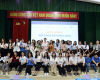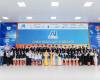


Hanoi, 15 January 2026 – Demo Day of the Future Solutions Project – Shinhan Square Bridge Vietnam 2025–2026 (Social Open Innovation) took place in Hanoi, gathering more than 60 delegates representing investment funds, universities and research institutes, civil society organizations, businesses, and the press. The event marked a milestone in concluding the Proof of Concept (PoC) journey in Vietnam, where stakeholders reviewed implementation results, witnessed partnerships activated through the program, and recognized outstanding solutions with strong potential to scale their social and environmental impact in the next phase.
The project is funded by the Shinhan Financial Group Hope Foundation through United Way Worldwide, and coordinated and implemented by the Management and Sustainable Development Institute – MSD United Way Vietnam, in line with Vietnam’s approved startup support orientation under Decree 80/2021/ND-CP, with accompanying support from the National Startup Support Center (NSSC).

Technology experience at Demo Day
SOCIAL OPEN INNOVATION – PUTTING COMMUNITIES AND ECOSYSTEMS AT THE CENTER
The Future Solutions Project is built on the Social Open Innovation approach—where innovation does not take place only within companies or laboratories, but is opened to meaningful participation from multiple stakeholders, including universities and research institutes, civil society organizations, startups, the business community and investors, government agencies, and more. Innovation, therefore, is not only about creating new products, but about addressing Vietnam’s social, environmental, and sustainable development challenges.
Within this Social Open Innovation foundation, SOAR, an initiative of MSD, has been identified as the guiding philosophy and operating model throughout the Future Solutions Project. SOAR is not only about accelerating startups, but about building a launchpad for solutions to “take off” with the ecosystem, based on four pillars:
-
S – Social Impact: generating clear social and environmental impact
-
O – Open Innovation: co-creating with multiple stakeholders
-
A – Action & Evidence: acting based on data, evidence, and real PoCs
-
R – Responsible Scaling: scaling responsibly and in alignment with local contexts
Through SOAR, startups not only demonstrate technological feasibility, but also gradually establish their position within Vietnam’s innovation and sustainable development ecosystem.

Group photo
DEMO DAY – A MEETING POINT THAT ACTIVATES ECOSYSTEM ACTION
For this reason, unlike traditional acceleration programs, Future Solutions is designed as a Social Open Innovation model—where startups do not develop solutions in isolation, but co-create with the ecosystem and are “placed” into real-world implementation contexts from the start.
The core of Demo Day featured 10 startups from Vietnam and South Korea, operating in two areas: Education in the New Era and Efficient & Sustainable Agriculture in Vietnam. Throughout the program journey, startups directly implemented PoCs in Vietnam to address specific challenges related to education transformation and technology adoption, optimizing agricultural production, reducing emissions, and promoting a circular economy.
This process followed a structured, practice-based roadmap: teams received intensive multi-stakeholder mentorship with the participation of startups, experts, partners, and host organizations (solution-receiving entities/agencies). They also worked directly with local target groups and partners—communities, schools, farmers, cooperatives, and businesses—to validate solution fit.
Based on field implementation, startups collected data and evidence, measured social and environmental impact indicators, and adjusted business models while shaping scaling strategies for the next phase. The PoC implementation and refinement period ran from 27 October to 31 December 2025, enabling startups to enter Demo Day with concrete results and evidence in the Vietnamese context.
Therefore, Demo Day was not merely a pitching event, but a convening point for the Social Open Innovation ecosystem—where solutions were discussed and assessed across multiple dimensions: relevance to local needs, social and environmental impact, and sustainable scalability in Vietnam.
(Photo of the Jury Panel)
Speaking about the program, Mr. Pham Hong Quat – Director General of the National Academy of Advanced Technology and Innovation under the Ministry of Science and Technology (former Director General of the National Agency for Technology Entrepreneurship and Commercialization) emphasized:
“In the context of Vietnam striving strongly to become a startup and innovation nation, we cannot rely only on the isolated efforts of each startup or each support program. Innovation becomes truly sustainable only when embedded in an ecosystem mechanism—where solutions have room to test, and are synchronously connected to policy, markets, and communities. The startups participating in Shinhan Square Bridge and the Future Solutions Project today are exemplary of that approach. They are not only developing technology; they have directly engaged with Vietnam’s real challenges in education, agriculture, and sustainable development; piloted solutions, generated data and evidence, and delivered tangible social impact. Most importantly, the program has helped build a collaboration platform among government agencies, research institutes and universities, businesses, investors, civil society organizations, and communities. This collective ecosystem effort is the driving force that enables startups not only to survive, but to grow, scale, and contribute in the long term to national innovation goals.”

Mr. Pham Hong Quat – Director General of the National Academy of Advanced Technology and Innovation, Ministry of Science and Technology
That “ecosystem spirit” was clearly reflected at Demo Day through the participation of government representatives, investors, and technical partners—key forces that connect solutions with resources, markets, and collaboration opportunities. The event featured a jury panel and community judges, representing diverse perspectives across the ecosystem—from research institutes and universities, startups and tech companies, civil society organizations, community representatives, to the media.
Sharing the meaning of the community-based evaluation mechanism, Ms. Nguyen Phuong Linh, Executive Director of MSD United Way Vietnam and Project Director of the Future Solutions Project, stated:
“The participation of community judges not only helps validate practicality, social impact, and contextual fit of solutions in Vietnam, but also clearly embodies the spirit of Social Open Innovation. We believe innovation is meaningful only when co-created with multiple stakeholders, when the voices of communities and end-beneficiaries are heard, and when no one is left behind in development. Demo Day is therefore not only a place to select solutions, but a launchpad for startups to SOAR—taking off with the ecosystem, with communities, and with social responsibility.”
Mr. Sukkun Sun, Project Owner of Shinhan Square Bridge, Shinhan Financial Group Hope Foundation, commented:
“Demo Day is the moment for startups to demonstrate their PoC journey through real results and data. We are truly proud to see the fast growth of startups within a short time—from the first meetings, to PoC implementation in Vietnam, to the changes, adjustments, and clear maturity of each solution. These outcomes would not be possible without the accompaniment and support of government agencies, partners, experts, civil society organizations, and communities who joined, shared, and enabled startups to test and learn in real contexts.”
Mr. Sun also shared:
“Within Social Open Innovation, startups not only provide technology, but serve as problem-solvers for real-world challenges—creating social value through solutions that improve lives and communities, with sustainable models and scaling potential. Demo Day is therefore not an endpoint, but only the beginning of the next journey for startups together with the ecosystem.”

Mr. Sukkun Sun, Project Owner of Shinhan Square Bridge, Shinhan Financial Group Hope Foundation
From this multi-stakeholder dialogue and connection platform, the Organizing Committee also witnessed and announced partnerships formed through the project—tangible outcomes of Social Open Innovation, where pilots were translated into longer-term commitments between startups and partners. Notable collaborations include: BizCare × Plantner, Ecosoi × Kymviet, Ecosoi × Saigon Heritage by Lê House, DDOIT × Zodiac Clarity, and MSD United Way Vietnam × Shoes Agtech.
After startup presentations and dialogue, the program announced the award results:
-
Champion Prize (USD 10,000) – Vandalsoft, a smart agriculture solution for insect farming as food: Vandalsoft provides management/digital transformation solutions for insect farming models, while researching feed optimization using agricultural by-products and converting waste into agricultural inputs. The PoC focused on testing alternative feed sources from by-products, optimizing formulations, and assessing the ability to produce organic fertilizer from insect-farming waste.

Champion – Vandalsoft
-
First Runner-up Prize (USD 7,500) – Shoes Agtech – Airboots (an ultra-light multifunctional agricultural robot): Shoes Agtech develops an ultra-light agricultural robot for seeding/fertilizing/spraying to partially automate cultivation and optimize input use. The PoC compared Airboots S30 with traditional spraying and drones in An Giang (each option 750 m²), recording 87% lower energy consumption than drones, 60% less rice stem breakage than traditional spraying, and 95.5% leaf folder pest control effectiveness after 01 day.

First Runner-up – Shoes Agtech
-
Two Third-place Prizes (USD 5,000 each) awarded to:
-
Plantner – eco-friendly fertilizers from natural ingredients/local by-products: Plantner develops fertilizers tailored to crop needs, leveraging natural and local by-products to reduce the impact of agricultural chemicals. The PoC was implemented on 14 hectares across crop groups (watermelon, rice, leafy vegetables in Hanoi, and citrus). The company reported a phased scaling plan to over 1,000 hectares, in coordination with the Can Tho Agricultural Extension Center and SunRice, and reported a 13% increase in soil organic matter after use, based on internal monitoring.
-
Recycle Ledger – a B2B trading platform for used cooking oil (UCO): Recycle Ledger builds a platform for UCO collection and trading, with traceability data supporting refining–recycling chains and biofuel certification. The PoC piloted with 30 restaurants, 2 aggregators, and 10 individual collectors, tracking 25.1 tons of UCO, estimating a contribution of 138 tCO₂e reductions, and increasing UCO recovery rates in the pilot group from 12.7% to 30%.
-

Second Runners-up – Recycle Ledger (left) and Plantner (right)
-
Community Vote Award – Ecosoi, converting discarded pineapple leaves into sustainable textile fibers: Ecosoi utilizes pineapple leaf waste to produce textile fibers, promoting circular economy and reducing agricultural waste. The PoC tested the collection–processing–spinning–sampling chain, targeting diversion of 60 tons of fresh pineapple leaves per month and increasing the pineapple fiber blending ratio to 30–40%. Results recorded 2 tons of blended fiber (40/60 pineapple–cotton) and a 20% cost reduction compared to the previous product.

Community Vote Award – Ecosoi
Closing Demo Day, the program reaffirmed the spirit of SOAR: solutions can truly “take off” only when rooted in real needs, validated through evidence from implementation, and supported by ecosystem collaboration. This is also the Future Solutions Project’s commitment to continue connecting resources and partners so initiatives can scale social and environmental impact sustainably, contributing concretely to the Sustainable Development Goals (SDGs).
INFORMATION ON THE 10 SHINHAN SQUARE BRIDGE STARTUPS 2025–2026
-
ABRAHMS – VOC/air emission treatment solution for manufacturing spaces: ABRAHMS develops a VOC treatment system combining adsorption and oxidation to reduce odor and emissions in areas using solvents/painting activities. The PoC was deployed at a wood manufacturing facility with a spray room in Hanoi, installed on 22/11/2025 and operated during 23/11/2025–16/01/2026, recording 86% VOC removal efficiency under real operating conditions (24/11/2025).
-
DDOIT – ResQ XR (immersive XR/VR safety learning): DDOIT develops XR content using VR and motion recognition, helping learners practice safety skills through simulated risk scenarios. In Vietnam, the startup localized 06 modules and conducted 03 training sessions at Anh Linh Charity School (Ho Chi Minh City), recording a 21% increase in safety awareness after 02 XR-based sessions.
-
Ecosoi – converting discarded pineapple leaves into sustainable textile fibers: Ecosoi utilizes pineapple leaf waste to produce textile fibers, promoting circular economy and reducing agricultural waste. The PoC tested the collection–processing–spinning–sampling chain, targeting diversion of 60 tons of fresh pineapple leaves per month and increasing the pineapple fiber blending ratio to 30–40%; results recorded 2 tons of blended fiber (40/60 pineapple–cotton) and a 20% cost reduction compared to the previous product.
-
MetaCode H – VI-Metachat (AI-powered learning support chatbot): MetaCode H develops a chatbot that helps students ask questions and receive responses aligned with the national curriculum, emphasizing structured learning-source retrieval to improve relevance and reduce hallucination. The PoC ran for 03 weeks (12/2025) with 200 Grade 11 students at Moc Ly High School (Son La) and Ms. Thuy Center (Hung Yen), evaluated via A/B testing and pre-test/post-test; the average score increased from 2.93 to 6.13 (+109%).
-
Plantner – eco-friendly fertilizers from natural ingredients/local by-products: Plantner develops fertilizers tailored to crop needs, leveraging natural and local by-products to reduce the impact of agricultural chemicals. The PoC was implemented on 14 hectares across crop groups (watermelon, rice, leafy vegetables in Hanoi, and citrus); the company reported a phased scaling plan to over 1,000 hectares, in coordination with the Can Tho Agricultural Extension Center and SunRice, and reported a 13% increase in soil organic matter, based on internal monitoring.
-
Recycle Ledger – a B2B trading platform for used cooking oil (UCO): Recycle Ledger builds a platform for UCO collection and trading, with traceability data supporting refining–recycling chains and biofuel certification. The PoC piloted with 30 restaurants, 2 aggregators, and 10 individual collectors, tracking 25.1 tons of UCO, estimating a contribution of 138 tCO₂e reductions, and increasing UCO recovery rates in the pilot group from 12.7% to 30%.
-
S-Duck – science learning solution combining hand-motion tracking and practical software: S-Duck enhances hands-on learning experiences in classrooms through a visual solution optimized to reduce reliance on specialized devices. In the PoC, the startup localized content, tested device compatibility, and measured learning engagement; it recorded 20 localized contents (Vietnamese/English) running on common devices and deployable via USB, and internal surveys showed average feedback scores of 4.8 from teachers and 4.7 from students (80 samples).
-
Shoes Agtech – Airboots (an ultra-light multifunctional agricultural robot): Shoes Agtech develops an ultra-light agricultural robot for seeding/fertilizing/spraying to partially automate cultivation and optimize input use. The PoC compared Airboots S30 with traditional spraying and drones in An Giang (each option 750 m²), recording 87% lower energy consumption than drones, 60% less rice stem breakage than traditional spraying, and 95.5% leaf folder pest control effectiveness after 01 day.
-
Thanks Carbon – digital MRV and nature-based carbon credits (NbS): Thanks Carbon implements nature-based carbon credit projects (AWD for rice) and an MRV platform using satellite data and AI. The PoC in Dong Thap/An Giang collected digital farming logs and AWD verification data; the startup reported FieldSense at 99.6% (field boundary identification) and FLOW at 100% (water presence detection), and estimated average emissions reductions of approximately ~1.74 tCO₂eq/ha on AWD-applied plots.
-
Vandalsoft – a smart agriculture solution for insect farming as food: Vandalsoft provides management/digital transformation solutions for insect farming models, while researching feed optimization using agricultural by-products and converting waste into agricultural inputs. The PoC focused on testing alternative feed sources from by-products, optimizing formulations, and assessing the ability to produce organic fertilizer from insect-farming waste.
Learn more about the program and the startups in the Future Solutions Project handbook: https://heyzine.com/flip-book/3fa4c6803c.html